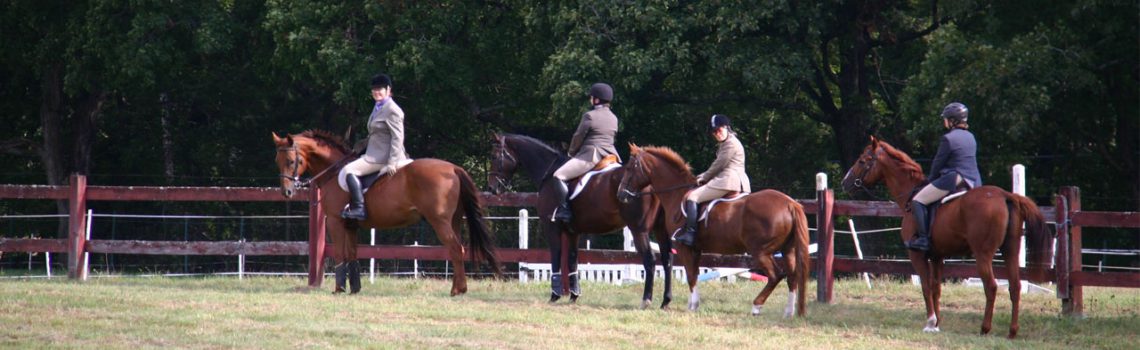
I’ve written before about how to massage your horse. I’m a big fan of Jim Masterson’s DVD. But I’ve never before seen a video of a horse massaging a human. I need to teach my boy how to do this!
Monthly Archives: March 2009
Lessons Remembered: Learning to Let Go
Not long after I got my current OTTB I remember riding him in a lesson and feeling that he was going pretty well. He was hot but “packaged.”
My trainer then reminded me that if I was holding him together the entire time, I was losing the ability to communicate with him. She told me I had to let go. Not necessarily dropping my horse but maintaining a soft giving contact that would allow a conversation with him.When you have a soft contact you can feel what’s going on with your horse and you can feel him reaching into the contact and relaxing through is back; muscling your horse onto the bit might look like there’s a connection, but it’s only a one way conversation. Heavy pulling sets up resistance in the horse’s jaw and neck and actually can make your horse off balance by putting more weight on his forehand.
Letting go of a horse that’s wired to go can be scary. Keep in mind that when racehorses are galloped jockeys use a steady hard contact so they associate that with going fast. I started to “let go” of my horse in a ring. After all, it’s not like he could go anywhere. Letting go forces the horse to rebalance himself and makes the rider start to use other aids to slow him down. This is where your balance comes into play: half halts done through your seat and back. And I needed all of the tricks I could muster because he went pretty darn fast.
But once he realized that I wasn’t going to keep him in a death grip of control, he started to listen and to slow down. In fact, most of the time now he seems most comfortable in a light contact where he’s reaching toward the bit and accepting it.
We still have moments where I forget to let go. One of them was yesterday. My horse has a serious case of spring fever. He wanted to go and he didn’t want to pay attention. In the middle of my ride I realized that my body was tight and I had a death grip on my rein. I started working him in figures (circles, 8s, etc.) to slow him down and remembered to give with my hands and use my other aids to ask him to slow down. I’d be lying if I said he was good, but at least he got better and I had some nice work at the end where he was swinging through his back and more relaxed.
Can the Human-Horse Connection Help Autism?

Rowan Isaacson and his father Rupert.
This is an amazing story. I’ve oversimplified it here, but have provided links below to both a short video and an article that gives more detail.
A young boy, Rowan Isaacson, is diagnosed with what may be autism.
When he’s three, his father discovers that his son has an amazing connection with a neighbor’s horse, a Quarterhorse mare named Betsy. Around Betsy, the boy’s tantrums stop, he begins to speak lucidly and he even (for the first time) talks of loving another creature.
The boy and his family go to Mongolia where they embark on a journey to Northern Mongolia, the last place on earth with Wild Horses and where shamans — traditional healers — are available to work with this boy. After the trip he is considerably changed. While he still has many of the characteristics of autism, he is better able to express himself, has fewer tantrums and is more connected to the world.
The book about his family’s experience The Horse Boy: A Father’s Miraculous Journey to Heal His Son is published by Viking and will be available on April 14th.
Read more about this story and watch the video below.
Cribbing Part II: Does cribbing cause health problems?
.jpg)
Cribbing is a behavior that horses seem to adopt to deal with stress or anxiety.
Tuesday’s article covered some of the theories on why horses crib. Today I’m going to talk about some of the health problems associated with cribbing. Here are three statements from three different people on a recent forum post about cribbing. These folks articulate pretty well the fears that people have about owning a cribber.
“Been there done that and I had to give the mare away after spending hundreds (perhaps thousands! I didn’t add up the losses) in trying to get her in good health, weight and condition. Then in trying to get the damn horse to EAT! Yup, she’d crib instead of eating.”
“I personally did fret over my cribber. I was told his cribbing caused his colics and his colics were going to kill him. I fretted muchly for many years. One reason I would never have another cribber is to avoid the frettingness.”
“my beautiful wood fences..are being replaced – had to send that one down the road. He drove me NUTZ because he would rather crib than eat, would crib on the buckets, literally anything that didn’t move. He was also prone to colic . . .”
In a nutshell people worry about:
Horses colicing. It is widely believed that colic from cribbing is caused by the ingestion of air which, in turn, causes gas distention in the intestinal tract. It turns out that is not actually true. According to Katherine A. Houpt, VMD, PhD, Dipl ACVB, director of the Cornell’s Animal Behavior Clinic, “Little of the air is swallowed, and few horses actually develop colic, but owners dislike cribbing because of the damage it causes to fences and buckets when the horse pulls them.” McGreevey and Nichols et al found the same results in 1995.
There is a specific type of colic that cribbers get more frequently, but that is colic due to the entrapment of the small intestine in the epiploic foramen (an internal hernia). When this happens the blood supply is occluded and the only treatment is surgery. However the relationship between gas colic and cribbing is still not well understood. While it appears that horses that crib do often colic, there is no compelling evidence that gas colics are caused by cribbing; the
The worn down teeth of a cribber
Teeth problems: Horses that crib compulsively can wear down their front teeth to the point where they become nubs which can make it difficult for them to graze. Horses that are mild cribbers probably won’t experience that much wear or it will take much longer.
Loss of Weight: Some cribbers have difficulty holding a good weight. It was thought that cribbing horses didn’t eat because they filled their stomachs with air (disproved above). Some horses simply prefer cribbing over eating! There is also some indication that horses that crib also have problems with effectively digesting their food (may/may not be caused by the cribbing or simply could be a co-existing behavior) so that they are just metabolically hard keepers.
Overdeveloped Neck Muscles: Because of the way a horse arches its neck to crib it can over develop the muscles on the underside of its neck which many people find to be unattractive.
Once a horse is an established cribber (much research shows that most cribbers start when weaned) it’s almost impossible to get them to stop entirely. However, there are ways to prevent horses from cribbing. I’ll take a look at those next.
Introducing the Equine Products Review Video Library
I love watching equestrian videos and there are a ton of good ones out there.
Rather than posting them here, I’ve created the Equine Products Review YouTube Channel for equestrian videos. It’s my collection of humorous, educational and inspirational videos about all things equine.
I’ll try to update the featured video every day, but if you have videos that you’d like to share, let me know!
Camouflage

Cribbing: Presumed Causes

Cribbing is a stable vice. Unlike wood chewing, the horse grabs a surface with its teeth and inhales air.
Many horse owners simply won’t buy a horse that cribs. Partially it is because they are harder to board (some barns won’t take them). Other owners worry too much that a horse that cribs is more prone health issues (such as colic) or harder to keep weight on.
However, according to Cornell Veterinary School, cribbing affects approximately 300,000 horses in the U.S., including 2.5% of all Thoroughbreds so you are likely to come across one sooner or later.
I’d never thought about it much before I got Freedom. He was supposed be a short-term foster horse so when I found out he was a cribber, I didn’t care. Of course, he never left and over the past four years I’ve learned a lot about horses that crib. And I’m still learning because theories about why horses crib keep evolving.
What is cribbing?
Cribbing is when a horse swallows air which is why this vice is also called “wind sucking”. Usually, the horse grabs a stationary object (like a fence) with its teeth, arches its neck, tenses the muscles along its back and neck and sucks air into its esophagus. Typically the horse makes a strange grunting sound while the swallow the air.
It differs from wood chewing (another bad habit) in that the horse doesn’t actually chew on wood but cribbing horses can damage fences and wooden surfaces which is why many barn owners ban horses that crib.
Why do horses crib?
No one knows for sure why horses crib. One thing most people agree on is that it’s an obsessive compulsive disorder that is very difficult (if not impossible) to “cure”.
Here are some of the most common theories:
- It’s a reaction to stress: sometimes horses start to crib when they are in intense training. Perhaps alleviating the gastric acidity caused by stress.
- It releases endorphins: some people believe that cribbing releases an endorphin that gives a horse a natural “high” so that once the behavior is learned it is reinforced by a pleasurable sensation. Recent research disproves this theory.
- It’s caused by boredom: virtually unknown among wild horses cribbing is a habit that only occurs among horses that are stalled. Certainly increasing turnout seems to decrease the amount most horses crib, but I’ve still seen cribbers out on grass that are cribbing on the fence.
- It’s a learned behavior: people worry that stabling near a cribber will cause another horse to crib. I suppose this can happen but my cribber didn’t teach my non cribber the habit during the nearly four years they were stabled together, nor did the other three horses turned out with him pick up this habit. While many barns have one or two cribbers, it’s very unusual for other horses to pick up the vice.
- It’s caused by dietary issues: horses on a high concentrate diet are more likely to crib.
- It’s a reaction to pain in its stomach: many people think that horses crib to relieve the pain caused by ulcers or excessively acidic conditions. However, studies where horses were fed the antibiotic Virginiamycin, which increases the pH in the hindgut of horses made no difference in cribbing behavior.
- It is a genetic condition. There are several factors that lend credence to a genetic predisposition to crib. Research conducted in Japan by Hosada in the 1950s showed that while cribbing rates across the equine population was less than 1%, in some lines of thoroughbreds the cribbing rate was as high 7%. For example 8.3% of the offspring and 6.4% of the next generation of the stallion Ryopan (a cribber) also cribbed. It appears that 25% of offspring of one cribbing parent and 50% of offspring of two cribbing parents cribbed. Similar results were discovered by Italian researchers Vecchioti and Galanti in 1986. They found that in a population of 1035 thoroughbred horses the incidence of cribbing overall was 2.4%. However, among certain “family” lines the incidence was as high as 44%.
My money is on a combination of genetic predisposition and environmental factors. We have two OTTBs at our barn right now and both crib even though they now have 24/7 turnout, free choice hay and have low concentrate diets.
Tune in tomorrow for more on the health issues associated with cribbing and ways to prevent horses from cribbing.
Say “Neigh” to Hay

Pandora needs to be completed covered to protect her from the grass. Photo: Murray Sanders.
While many of us are coaxing grass to grow in our small muddy paddocks, for a horse like Pandora, dirt lots are the only choice. The 5 year old TB mare is allergic to grass!
The allergic reaction surfaced last summer with a large itchy boil. Now the mare needs to be covered from head to toe least she come into contact with even a single blade of grass.
Pandora still gets turnout time but she’s protected by a flysheet, a fly mask, wraps up her legs and a tail cover.
What do you feed a horse allergic to grass? Pandora seems to thrive on beet pulp, soy oil and 15 antihistamine tablets a day!
See the article in the UK Daily Mail.