

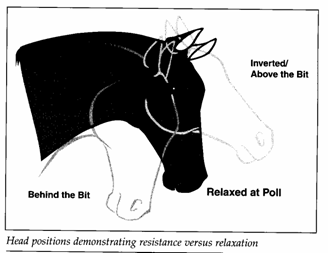
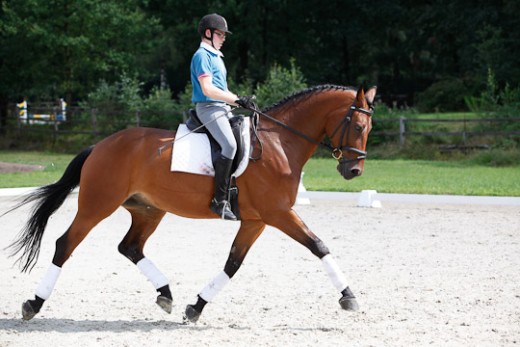
A horse is considered to be on the bit when it has engaged its back and hind quarters and reached into an accepting contact with the rider. When discussed in terms of dressage, a horse that is on the bit has its head positioned on the vertical and its poll is the highest point. Many horses, especially in the beginning stages of establishing connection, may poke its nose out a bit or drop slightly behind the vertical.
In hunters, a horse should still be engaged through its

body and accepting an active contact, but it is more appropriate for its nose to be slightly poked forward. The horse is still engaging his back and is still balanced and light on his forehand.
This should not be confused with how a horse looks when it is above the bit. When a horse is evading contact by going above the bit it raises its head high, tense its underneck neck, tightens its back, and tenses its hindquarters.

With some horses, their conformation predisposes them to that way of going; other horses use it as a defense mechanism when the rider’s hands are not steady or when there isn’t enough impulsion.
When a horse is consistently ridden above the bit the under side of its neck becomes muscled, rather than the top of it’s neck. The horse tends to pull itself forward on its forehand rather than pushing from its hindquarters.
A horse that is behind the bit can deceive its rider into thinking it’s on the bit because the horse arches its neck and “poses.” In reality, there is no connection; the horse floats behind the bit and won’t accept

contact. My Trakehener learned that trick from a previous owner who had ridden him incorrectly in draw reins. He looked pretty but his neck position didn’t move, even when the reins were looped.
It’s hard to retrain a horse to accept contact when they have developed this evasion. You have to ride them very forward and use a kind bit that encourages contact.
The most important part to remember about getting your horse on the bit is that it is the result of good riding (riding your horse from the hind end forward, encouraging him to lift his back and accept contact) rather than by pulling on your horse’s mouth. Sometimes a horse can be a bit above or behind the bit and still be working his whole body and sometimes your horse can pose prettily but not accept the contact at all.